

诊断类研究Meta分析
GRADE评级的必要性
诊断类研究在医学研究中占据重要地位,基于诊断类原始研究开展的Meta分析在循证证据中占据重要地位。虽然,在开展系统综述的过程中,我们会采用偏倚风险评估工具(常用Quality Assessment of Diagnostic Accuracy Studies 2,QUADAS 2)对所纳入的原始研究进行偏倚风险评估。然而,结局证据的可信度却很难通过偏倚风险评估或质量评价来确定。因此,在部分研究中引入了GRADE(The GRADE approach to grading quality of evidence about diagnostic tests and strategies)评级系统对所纳入的原始研究进行结构化评估。
诊断类研究Meta分析的GRADE评级的作用
▶ 提升证据透明度
通过GRADE系统,我们可以清晰地指出每一项结局指标的证据质量,提高系统评价的透明度和可重复性。
▶ 支持临床指南制定
在制定临床实践指南时都强调基于GRADE系统进行证据分级。诊断性研究作为某些疾病诊断的主要证据来源,其GRADE评级直接影响着推荐意见的强弱。没有经过GRADE评估的证据,很难支撑起有力的临床推荐。
▶ 推动未来研究方向
GRADE评估不仅关注当前证据的质量,还能为未来研究提供方向。例如,如果某项结局因样本量不足被评为“低质量”,那么这就提示我们需要更多大样本、多中心的研究来验证该结论。
诊断类研究的GRADE评级的介绍
GRADE评估结果包括“高级别”、“中等级别”、“低级别”和“极低级别”四个等级。其从研究设计(Study design)、研究设计和/或执行的局限性(偏倚风险)(Limitations in study design and/or execution (risk of bias))、间接证据(Indirectness of evidence)、结果不一致(Inconsistency of results)、结果不精确(Imprecision of results)、发表偏倚(Publication bias)角度进行评估。以下,我们对诊断试验的GRADE进行简要介绍[1]。
|
Factors that determine and can decrease quality of evidence |
Explanations and differences from quality of evidence for other interventions |
|
Study design |
Different criteria for accuracy studies—Cross sectional or cohort studies in patients with diagnostic uncertainty and direct comparison of test results with an appropriate reference standard are considered high quality and can move to moderate, low, or very low depending on other factors.
|
|
Limitations (risk of bias) |
Different criteria for accuracy studies—Consecutive patients should be recruited as a single cohort and not classified by disease state, and selection as well as referral process should be clearly described. Tests should be done in all patients in the same patient population for new test and well described reference standard; evaluators should be blind to results of alternative test and reference standard. |
|
Indirectness: |
|
|
Outcomes |
Similar criteria—Panels assessing diagnostic tests often face an absence of direct evidence about impact on patient-important outcomes. They must make deductions from studies of diagnostic tests about the balance between the presumed influences on patient-important outcomes of any differences in true and false positives and true and false negatives in relation to complications and costs of the test. Therefore, accuracy studies typically provide low quality evidence for making recommendations owing to indirectness of the outcomes, similar to surrogate outcomes for treatments. |
|
Patient populations, diagnostic test, comparison test, and indirect comparisons |
Similar criteria—Quality of evidence can be reduced if important differences exist between populations studied and those for whom recommendation is intended (in previous testing, spectrum of disease or comorbidity); if important differences exist in tests studied and diagnostic expertise of people applying them in studies compared with settings for which recommendations are intended; or if tests being compared are each compared with a reference (gold) standard in different studies and not directly compared in same studies. |
|
Important inconsistency in study results |
Similar criteria—For accuracy studies, unexplained inconsistency in sensitivity, specificity, or likelihood ratios (rather than relative risk or mean differences) can reduce quality of evidence.
|
|
Imprecise evidence |
Similar criteria—For accuracy studies, wide confidence intervals for estimates of test accuracy or true and false positive and negative rates can reduce quality of evidence.
|
|
High probability of publication bias |
Similar criteria—High risk of publication bias (for example, evidence from small studies for new intervention or test, or asymmetry in funnel plot) can lower quality of evidence. |
表1 降低诊断准确性研究证据质量的因素及其与其他干预措施证据的差异
示例文章
在Natanasabapathy V等[2]研究超声成像与组织病理学鉴别诊断牙髓根尖周病变的系统评价和荟萃分析中,对诊断结局进行了GRADE评级(图1)。
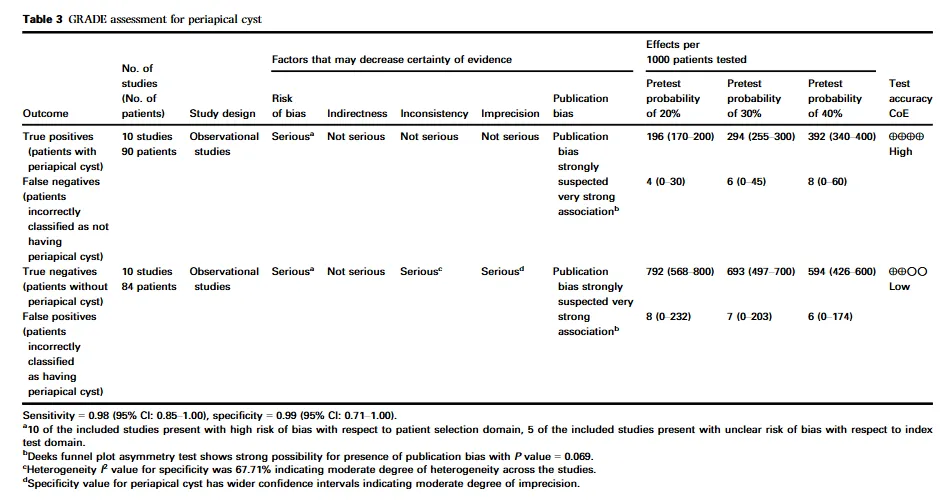
图1 示例范文中GRADE评级结果
总结
在循证医学实践中,基于诊断类研究的循证证据具有不容忽视价值,但其证据质量也不能盲目高估。通过GRADE系统对其进行系统评估,是确保系统评价科学性、指导临床实践和推动科研发展的重要手段。
参考文献
[1] Schünemann HJ, Oxman AD, Brozek J, et al. GRADE Working Group. Grading quality of evidence and strength of recommendations for diagnostic tests and strategies. BMJ. 2008 May 17;336(7653):1106-10. doi: 10.1136/bmj.39500.677199.
[2] Natanasabapathy V, Arul B, Mishra A, Varghese A, Padmanaban S, Elango S, Arockiam S. Ultrasound imaging for the differential diagnosis of periapical lesions of endodontic origin in comparison with histopathology - a systematic review and meta-analysis. Int Endod J. 2021 May;54(5):693-711. doi: 10.1111/iej.13465. Epub 2021 Jan 17. PMID: 33368404.







评论列表